Pages

Wednesday, 21 October 2020

Inverurie Bass Cemetery, Aberdeenshire

 Inverurie Bass Cemetery, Aberdeenshire

Visited August 2020

The old cemetery in Inverurie is on the southern outskirts of this market town in North-East Scotland, between the rivers Don and Urie. Most of the burials are Victorian and later, and the cemetery is still in use, but this is not the main draw.

There are some wonderful historical monuments within the cemetery. Most noticeable as you enter, there are the remains of the first Norman motte and bailey castle in north-east Scotland, built by the Lord of Garioch in the 1100s. It was, as with so many castles in Scotland, used by Robert the Bruce at one point. These two hills give the cemetery its name, and are known as the Bass and Little Bass. They're fenced off, but there's a gate into the motte and a steep path up to the top and a stile to get into the bailey.

At the foot of the motte, in a glass case, are four carved Pictish stones. They used to be out in the open in the cemetery, but following conservation have been moved and protected from the elements. They were previously built into the walls of the old church which once stood in the cemetery, and were found when it was demolished in the 18th century.

Despite the age of the site, most of the memorials are late Victorian and later, with the cemetery still in use today. Memorials are organised in neat rows, with a couple of circles in the middle. There are some fine memorials in local grey granite, but no epic mausoleums.


Thursday, 8 October 2020

Kinkell Church, Aberdeenshire

 Kinkell Church, Aberdeenshire

Visited August 2020


Kinkell Church is a ruined church and associated churchyard in north east Scotland, under the care of Historic Scotland. It's down a small country road, and quite easy to miss, especially as the signs run out before the last junction!

The church has quite a history for such a small building. It was built in the 1200's as a simple, plain church - there's very little evidence for windows, but a selection of carved stone fragments on pallets at one end hints at a bit of decoration, probably from the east window. It was linked with the Knights Hospitallers in the 14th century, up until 1420. In the early 16th century it was remodelled and a sacrament house was added in the wall at one end in 1524, and although somewhat weathered the decoration can be seen. There's also a panel beside it depicting the crucifixion, although this is a replica - the original was removed some years ago and is now lost. In 1771 Kinkell Parish was merged with another nearby, and the church was abandoned and some of its stone used to build a new church in Keithhall

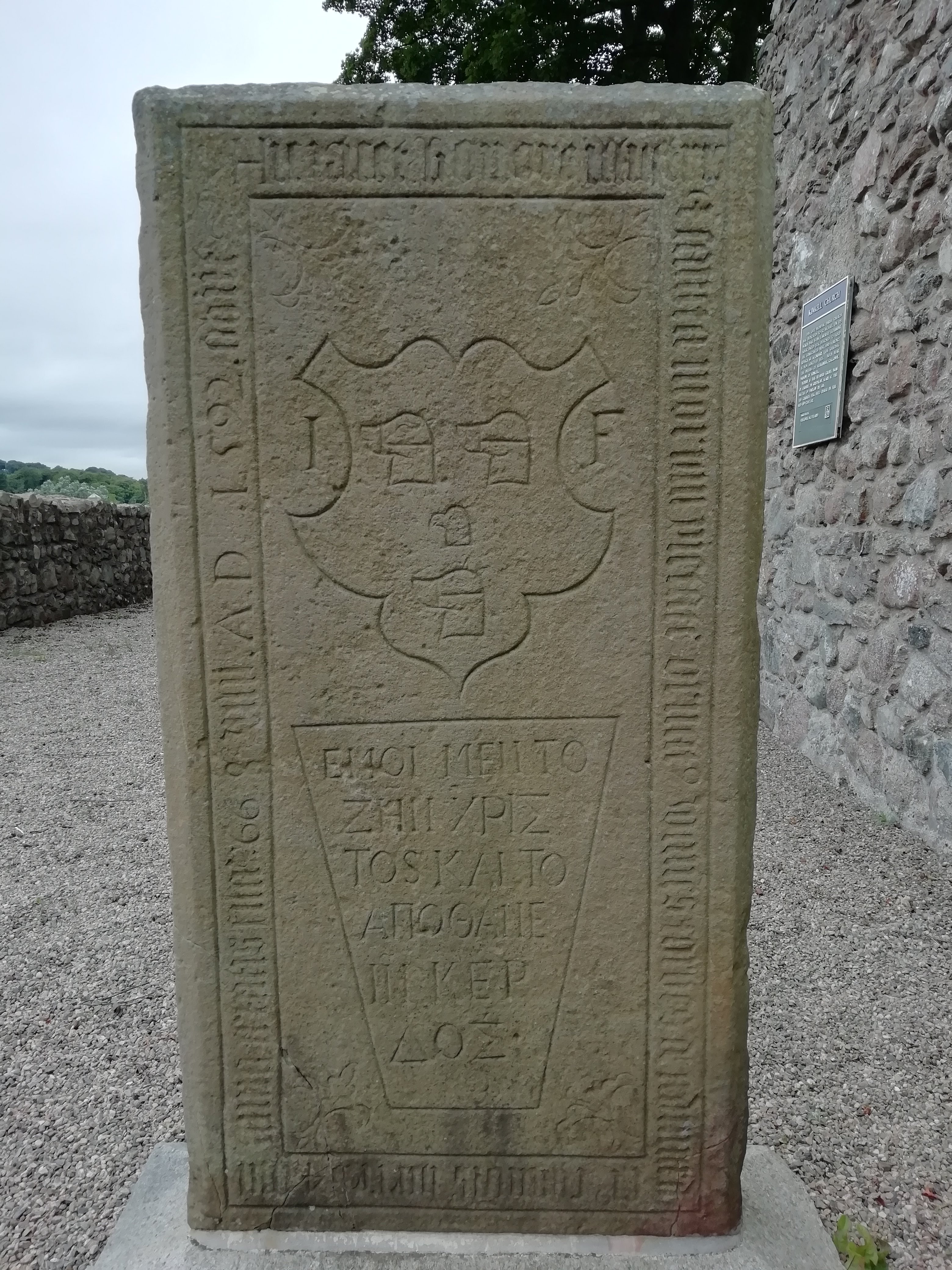
Within the church is a reused grave slab from the 15th century, which depicts Gilbert de Greenlaw, in armour, who died at the Battle of Harlaw in 1411. It was reused for another burial in 1592, when it was cut down so the knight is missing his lower legs, and a Greek New Testament text (the earliest in Scotland) added.

There are more gravestones in the kirkyard surrounding the ruin. A couple are old, with memento mori, and may date back to when the church was in use. Others are more modern, Victorian and 20th century. In one corner is a group of memorials to the Tait family, who for over 150 years until 2009 owned the large Tait Paper Mill in nearby Inverurie, whose chimney can be seen from the kirkyard.

Gravestone of Gilbert de Greenlaw

Gravestone of Gilbert de Greenlaw

Memento Mori, Kinkell Church


Tait memorials, Kinkell Church
Tait memorial, with chimey of paper mill seen in top left
corner


Kinkell Church ruin with gravestones in front


Thursday, 1 October 2020

Resurrection Stone, St Andrews Holborn, London

 Resurrection Stone, St Andrews Holborn, London

Visited August 2020


This isn't a burial marker (although a few remain in the garden nearby, see photo second from bottom), but a splendid carving showing the dead being resurrected on the Day of Judgement. It likely dates from the late 17th century, and used to stand over the entrance to a pauper's burial ground on Shoe Lane, now completely vanished from trace and covered with modern buildings.

The stone is set in the exterior wall of St Andrews Holborn, and can be seen from the road at a distance or quite easily by going down into the landscaped churchyard. It's difficult to get up close to some parts due to being over a door and stairs down to the door, but there's a cracking 3D render of it here.

It's carved with scenes of the Last Judgement, with Christ in the centre welcoming the risen to his Kingdom with cherubs blowing trumpets to either side of him. Down below the dead clamber out of their coffins on the Last Day and reach upwards, and angels appear to guide them. It's a hopeful scene (despite the coffins and dead), and suggests that everyone is heading Heavenwards, rather than towards Hell. It was placed at the entrance to a pauper's burial ground, where it's likely very few of the interred or their surviving families were literate, so may have been a visual symbol of hope; the fact that all the dead are shown equal may also have been an indication that poverty was an earthly thing, and all are equal in the eyes of God?

There are two other resurrection scenes of this type in London which I've yet to visit. St Giles in the Fields has one carved in wood, which used to be part of the gateway. It's been replaced with a cast, and the original is inside the church to preserve it. I've walked past the church for many years but didn't spot the gate until researching this stone! So next time I'm in Bloomsbury or Soho, I'll go and find it. St Mary on the Hill in the City of London also has a resurrection stone, likely from over the entrance to the burial ground and again moved inside for safe-keeping. Another one to track down!


complete view of resurrection stone over church doorway


Detail showing dead in open coffins and some climbing out of coffins


Wednesday, 23 September 2020

Rhynie Old Kirkyard, Aberdeenshire

 Rhynie Old Kirkyard, Aberdeenshire

Visited August 2020

Rhynie Old Kirkyard, in the little village of Rhynie near the foot of Tap O'Noth hillfort in Aberdeenshire, is a lovely, quiet place with an old feel to it. Accessed down a narrow road, there is a shelter in the carpark containing 4 Pictish stones. Two of these were found in the foundations of the old church when it was demolished,, and the field next to it contains the Craw Stane, still in situ, and is where the Pictish stone depicting 'Rhynie Man' was found.

Pictish stone in  car park of Rhynie cemetery

The cemetery was the kirkyard of the old St Luag's Church, which fell into disrepair in the late 18th century and was demolished in the 19th century and replaced by a new church in the village . There's no trace now of the old church, although I'm told if you look closely some old stones from it are built into the kirkyard wall. 

When you enter the kirkyard, you notice it's right on the edge of the village, with fields and woods on three sides. The gravestones in the area where you enter are from the 19th and 20th centuries (the kirkyard is still in use today) but head further back and things get older. Right at the back, against the west wall is the oldest in situ survivor a gothic looking memorial to local nobleman Alexander Gordon of Muirack, who died in October 1668. Strangely, it's located in the far corner from where the old church would have stood, possibly because he was a Catholic and the kirk was very much Presbyterian.

Beside Gordon's memorial is a Medieval stone sarcophagus, much older than this memorial and not part of it. It was found when the cemetery was cleared in the 19th century. At this time, many of the 18th century gravestones were moved to make way for new burials, and left against the west wall of the cemetery. They are much weathered and fairly illegible, although some memento mori including winged souls and skulls can still be seen. 


Alexander Gordon's memorial

Detail of Alexander Gordon's memorial

Medieval stone sarcophagus

18th century memorials along the back wall


Thursday, 10 September 2020

Harty Church, Isle of Sheppey (Kent)

St Thomas the Apostle Church,  Harty, Isle of Sheppey
Visited July 2020

On my first day out of London as lockdown eased, we headed to the Isle of Sheppey, on the east coast of Kent. An area with a lot of history (it's said by some that the Isle of Harty, now fused to the Isle of Sheppey,was the site of 'Heorot', Hroþgar's hall and that it took its name from the main settlement there).

Harty has a lovely little church dedicated to St Thomas the Apostle, which dates back to the late 11th century, which was surprisingly open to visitors unlike most. There is some wonderful stained glass inside, and church is made more atmospheric by having no electricity or running water. Oh, and the homemade jam for sale just inside the door is amazing, do get a jar and pop your money in the donation box!

The churchyard appears to have been cleared relatively recently. It's very large given the size of the church and settlement, but with very few memorials. Around the back are some chest tombs, and a gravestone carved with memento mori and dating from 1748. Most of other stones are of the late 19th century, up to almost the present day.

It doesn't take long to visit here, but it's well worth the drive if you're on the island. You might even see some marsh harriers from the RSPB raptor viewpoint en route, we did!


Friday, 4 September 2020

The Bier House, Ospringe, Kent

The Bier House, Ospringe, Kent

Visited August 2020

Across the road from the Church of St Peter and St Paul, on the outskirts of village of Ospringe near Faversham in Kent is this bier house, one of only a handful in England.

The small flint bier house or mortuary house was probably built in mid-19th century, and was used to house coffins ahead of burial. It apparently stands on the site of a spring, which has long since dried up, although there was a stream and pond behind it in living memory, since ploughed out of existence. The window above the door is a re-used Medieval slit window. At the back is a contemporary toilet and urinal (delightful!) not accessible from the road. 

The building is locked, and used for storage by the church, but it's worth stopping for a look, and there's some parking across the road in front of the church which is also well worth a visit. Nearby, too, is the Stone Chapel, a Roman mausoleum (or possibly temple) of the 3rd Century which was later converted in the early Medieval period into a chapel, and extended later, until it fell out of use in the 16th century.


The Stone Chapel, Ospringe


Wednesday, 12 August 2020

Wells Cathedral, Somerset

Wells Cathedral
visited February 2020

Wells Cathedral, in the small town of Wells is a beautiful place to visit (although perhaps not on the rainy day in February when I visited!). It's got some glorious stained glass, the stunning West Front, a lovely chapter house, with very worn stairs to get to it, and splendid scissor arches. It is also, of course, the resting place of many of the great and the good of the area.

Sadly most of my photos don't seem to have come out of the many memorials around the building, but I was very excited to find a cadaver tomb, that of Bishop Thomas Beckington who died in the late 13th century. The other photo which came out is the memorial lined cloisters which, as with many cathedrals, are a peaceful place to spend a while.

Now the cathedrals are open again, do go and visit Wells, and take in the Bishop's Palace and Vicars' Close while you're in the city.