Pages

Friday, 29 July 2016

The Great Cemetery, Riga, Latvia

The Great Cemetery, Riga, Latvia
Visited July 2016

This lovely wooded cemetery is about 2km out of the centre of Riga, the capital city of Latvia. It's a pleasant walk or a short tram ride to get there, and on a sunny weekday morning there were a few dog walkers, some joggers and me there.

The cemetery covers 22 hectares, and was founded in 1773 (thanks to Russian legislation banning burials in churchyards in the early 1770s) before finally being closed to burials in 1957. Sadly, it was badly damaged during the second Soviet occupation (from 1944 to 1991), with a lot of monuments bulldozed in the 1960s when it was converted into a park. One well preserved area is the Russian Orthodox Cemetery, separated by a road from the main part of the cemetery, and now renamed Pokrov Cemetery (see separate blog post).

Many of the remaining monuments and mausoleums are in a poor condition, although there are signs of restoration work in some parts. Most interesting to me were the wonderful gravestones in the form of tree stumps, complete with roots, leaves and insects. I've never seen the like before!

Should you find yourself in Riga, and can tear yourself away from the sites of the old town and art nouveau district, I highly recommend you come here for some greenery and time out from the hustle and bustle.


Friday, 3 June 2016

Brompton Cemetery, London

Brompton Cemetery, London
Visited October 2014

A third (photographic) visit to this lovely Victorian cemetery in Kensington and Chelsea. Although quite busy with walkers, it's such an atmospheric place in black and white!


Saturday, 28 May 2016

East Sheen Cemetery, London

East Sheen Cemetery, London
Visited March 2014

East Sheen Cemetery, near Richmond, was originally known as Barnes Cemetery when it opened in 1906. It adjoins Richmond Cemetery, with only a hedge marking the boundary. It sits in what was once woodland, and a number of mature trees still surround the cemetery. Both cemeteries are still in use, and the chapel in East Sheen is used for services for both East Sheen and Richmond cemeteries. To get to it is a short walk up what feels like a country lane off a busy main road into Richmond

Being a 20th century cemetery there aren't any large Victorian melodramatic tombs here, but there are some splendid early 20th century memorials. The most famous, and rightly so, is the wonderful over-life sized bronze angel draped in mourning over a stone sarcophagus. This is the Lancaster Memorial dating from the early 1920s and it is Grade II listed - and it may be my favourite ever memorial. 
 
Other monuments include the stone soldier standing at the grave of William Rennie O'Mahony, and there are other lovely graves among some other quite plain ones. A lovely place to visit, although as it's still in use to take care not to intrude on mourners. 


Friday, 6 May 2016

St Augustine's Church, Ramsgate, Kent

St Augustine's Church, Ramsgate
Visited April 2015

Also known as the Shrine of St Augustine of Canterbury, this Roman Catholic church in Ramsgate was designed by Augustus Pugin, the celebrated Gothic Revival architect responsible for the interior of the Palace of Westminster. It sits alongside other buildings by Pugin, including his home, The Grange, next door, and he is buried in the church. The church is frequently open to visitors, and is well worth a visit - I've included some photos of the interior here as well as the burial ground which sits between the church and the sea. A new visitor centre will open in 2017 where visitors can find out more about Pugin and Ramsgate.

The churchyard is quite small, and dates from the 1850s onwards. Many of the graves are quite plain, but there are a few rather ornate ones, some in the Italian Catholic tradition. As it was a grey day I didn't spend as long as I'd have liked exploring, so maybe I'll have to go back next time I'm in Kent!


Thursday, 28 April 2016

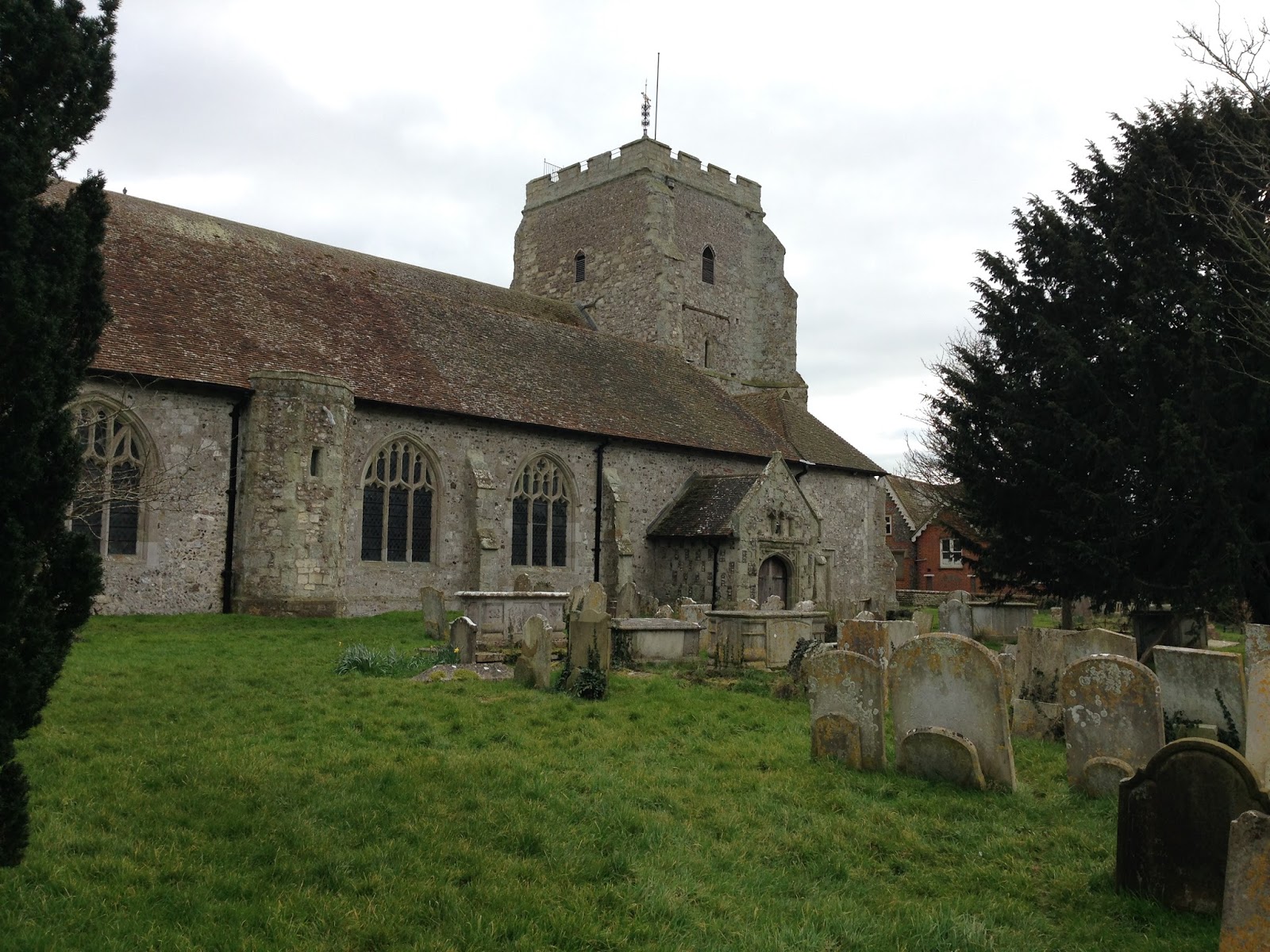
Churchyard of St Mary, Westham

Parish Church of St Mary, Westham, East Sussex
Visited March 2016

This church is believed to be the first built by the Normans after the conquest of 1066 (the site of the infamous battle of Hastings is nearby in the town of Battle). It stands close to the site of Pevensey Castle, and the two were probably connected. The church itself has original features dating back to the late 11th century, with renovations and restorations going up to the 20th century.

The churchyard is still in use, and most of the simple gravestones date from the 19th century onwards; I only managed to find one earlier stone with memento mori features on it. But, it's in a lovely country setting, so could easily be fitted in with a visit to the Castle. Look out, in one of the modern parts, for the graves from the 1930s most of which appear to have a coppiced tree growing out of them (no bones coming up with the roots, I checked!).


memento mori skull,St Mary's, Westham
 

Saturday, 16 April 2016

Forbes Mausoleum, Falkirk, Scotland

Forbes Mausoleum, Falkirk
Visited September 2015

The Forbes Mausoleum sits in the grounds of Callendar Park in Falkirk, and is located to the south east of Callendar House. It's about a 15 minute walk through the woods to the mausoleum, but you really don't want to walk there alone. 

It was designed in 1816 by Archibald Elliott in the Greek Doric style to house the remains of the Forbes family, who owned Callendar House from 1783 until the mid-20th century. It must have been impressive when build. Nowadays however, it's covered in graffiti as is the circular enclosure wall. The ground around it is covered in litter, empty bottles and traces of bonfires, and it just feels sad and neglected.
 
Forbes Mausoleum, Falkirk


Sunday, 10 April 2016

St Mary's Churchyard, Eastbourne

St Mary's Church, Old Town, Eastbourne, East Sussex
Visited March 2016

Although parts of this church date from the 12th century (more building went on in the 14th century, and there was a huge refurbishment in the Victorian period), most of the memorials in the churchyard are Victorian onwards. Apart from a small area to the east side, most of the gravestones have been cleared and lie against the walls. Part of the churchyard is still in use, as a garden of rest for cremations of parishioners. 

There are a few older monuments around, and (perhaps rather randomly) a Celtic cross brought from Cornwall to Eastbourne in 1817, which probably dates to the 12th century. It's not worth making the journey to visit the churchyard alone, but the church itself is lovely. No pictures, as there was a service when I was there, but it retains some splendid original features including stone carvings.