Pages

Showing posts with label Scotland. Show all posts

Thursday, 31 January 2019

St Cuthbert's churchyard, Edinburgh

St Cuthbert's Churchyard, Edinburgh
Visited July 2018

At the end of Princes Street Gardens, and in the shadow of Edinburgh Castle, is the parish church of St Cuthbert's, surrounded by its historic graveyard. The church dates from the late 19th century, but there have been churches on the site since at least the 12th century, if not a few centuries earlier.

 Although it's got stunning views over the Castle, and opens directly onto the Gardens, it was quiet when I visited on a Saturday afternoon at the end of July.

The gravestones here are a real mix - in the oldest part there are loads of skulls and other memento mori symbolism, with graves dating back to the 17th century. In the northern sections the Victorian and more recent gravestones are plainer, and arranged in rows, but there are some interesting insights into the social history of the time, as so many include details of the roles in society of those buried there, not just names, dates and epitaphs.

Should you find yourself at the far end of Princes Street, do go in here - it's not nearly as well known as Greyfriars, but is just as interesting, if not more so, and much, much less visited. A true gem in the heart of Edinburgh!


Gravestone with skulls, St Cuthbert's Churchyard, Edinburgh


Sunday, 31 December 2017

St Ninian’s Church, Fetternear, Aberdeenshire

St Ninian’s Church (ruins), Fetternear, Kemnay, Aberdeenshire
Visited August 2017

This site, in woodland near the ruins of the Bishops Palace, is a curious one. Apparently there’s been a church dedicated to St Ninian here since c. 1150, and a new chapel was then built in 1848. The present building, dating from 1878, stands over the foundations of the earlier buildings and their burials (including family tombs of the Leslie family, and at least one bishop), but due to a falling out between the landowning family and the Catholic Church it was never consecrated.

There’s a small graveyard around the ruin, which is now out of use. Most of the graves date to the 19th century, although there may be older ones lurk8ng in the undergrowth. The remains of the burials within the building aren’t visible, although a bit more poking around might have brought forth a few traces.

In winter the site might be more accessible, but in summer in was surrounded by bracken to be waded through, watching out for fallen walls, rabbit holes and ticks! Although the area is popular with dog walkers, they didn’t stray from the paths to come to this place, and there wasn’t much evidence anyone ever did...


Thursday, 3 November 2016

Neolithic Burial Cairn, Crarae Gardens

Neolithic Burial Cairn, Crarae Gardens, Argyll, Scotland
Visited September 2016

Crarae Gardens are a National Trust for Scotland property in Argyll, western Scotland. The Himalayan gardens are wonderful to visit, albeit a bit remote on the banks of Loch Fyne. In spring the rhododendrons must be spectacular!

Not far inside the gardens are the remains of a Neolithic chambered cairn, dating to circa 3500BCE. Nowadays only the stones which formed the entrance and burial chamber remain, along with an interpretation board. They're not fenced off, so you can walk right up to them.

For lots of archaeological information on the site, and some photographs taken when the tomb was excavated, go to the Canmore website: https://canmore.org.uk/site/40024/crarae-garden


Saturday, 20 August 2016

Tarves Kirkyard, Aberdeenshire, Scotland

Tarves Kirkyard, Aberdeenshire
Visited August 2016

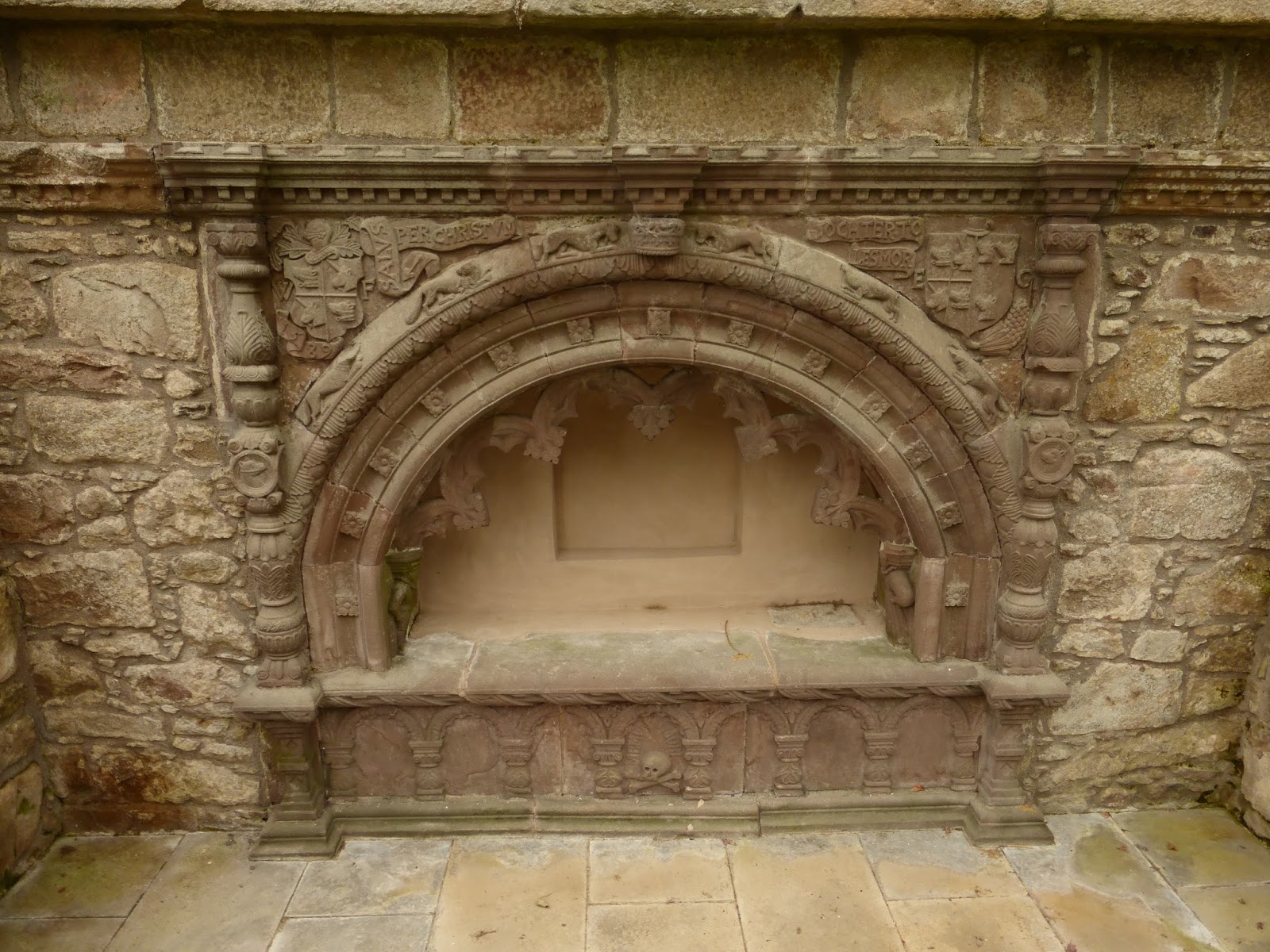
Tarves is a small village a few miles north of Aberdeen, with a most impressive tomb in its churchyard. Most of the graves date from the Victorian period onwards, and the church itself dates from 1798, but the site has been in use much longer than that. A Medieval church stood just to the south of the current one, and all that remains of it is the Tolquhon Tomb, a scheduled ancient monument and the tomb of William Forbes (died 1596), lord of nearby Tolquhon Castle (the ruins of which are also well worth a visit), and his wife Elizabeth Gordon.

The tomb itself is under a protective canopy, and you can't get right up to it, but it's worth seeking out, especially to see the carvings on it - although you can't quite see the small portrait statuettes of th couple. The design of the tomb is probably inspired by the 1532 tomb of Bishop Dunbar in St Machar's Cathedral in Old Aberdeen.


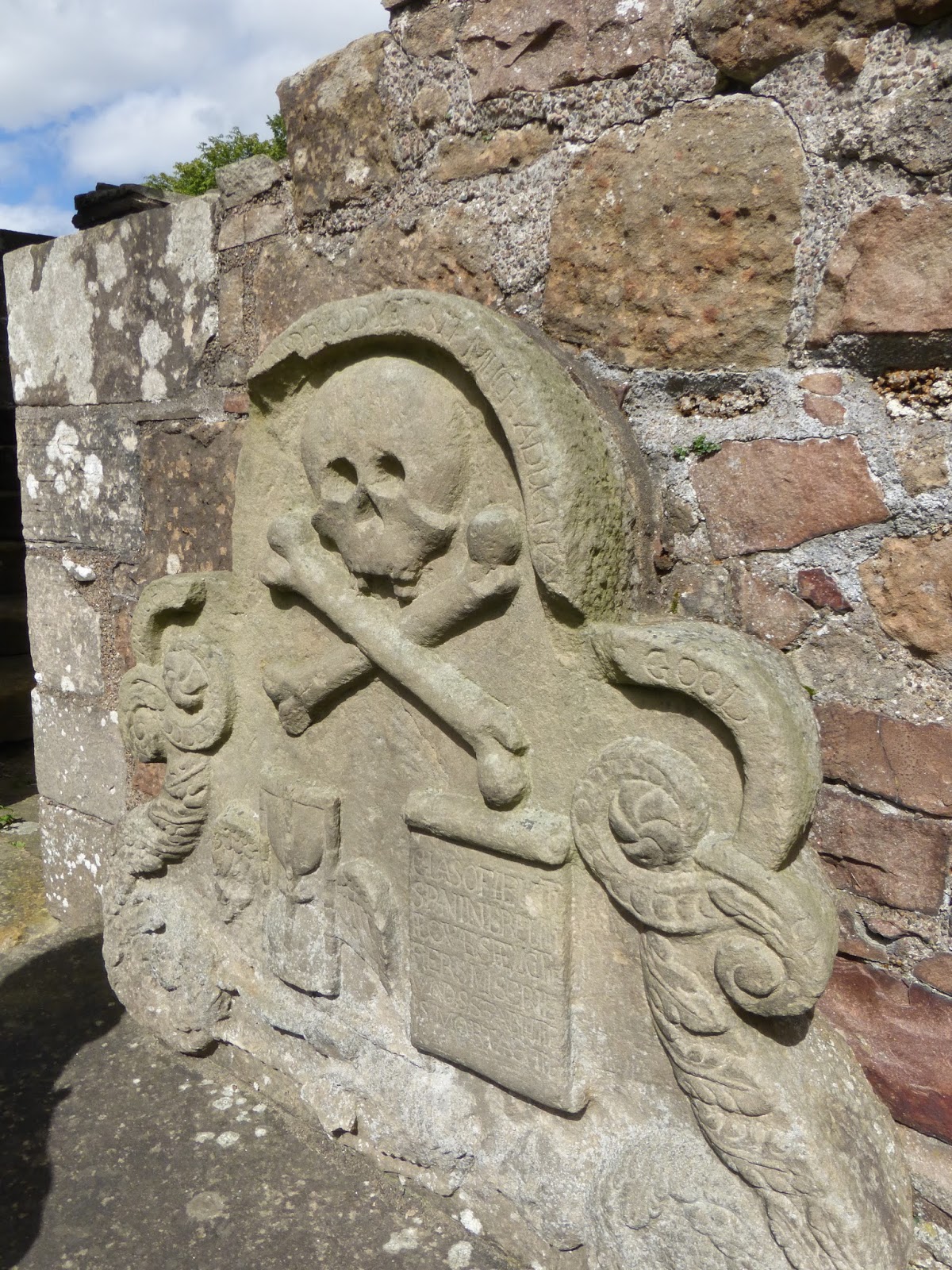
Leaning against the church wall, directly behind you from the Tolquhon Tomb, are 4 old grave slabs dating from the 1580s to 1630s, with wonderfully naive skulls on them, and inscriptions which remain legible to this day.


Wednesday, 7 October 2015

Larbert Old Parish Churchyard, Falkirk

Churchyard of Larbert Old Parish Church, near Falkirk, Scotland
Visited September 2015

A short walk away from the train station in the village of Larbert (now a suburb of Falkirk), is this lovely old churchyard. The earliest gravestones date from the 17th century, earlier than the current (19th century) church. An area of the churchyard is set aside for burials of the great and the good of the Carron Company, an iron making company established in Falkirk in the 18th century. This area contains a Doric Greek style mausoleum, among other

Notably, although there is no shortage of 18th and early 19th century gravestones, there are very few memento mori on the tombstones.

One thing to look out for, which fascinated me, is the large number of gravestones with a single date, and the names of a man and a woman. Why no dates of death? Because it was traditional than on their wedding, the couple would be gifted a burial plot and headstone! And if you notice that they have different surnames, that's because in Scotland in the 19th century it was still usual for a woman to retain her own surname after marriage. 


Monday, 14 September 2015

Elgin Cathedral Churchyard

Elgin Cathedral Churchyard, Moray, Scotland
Visited August 2015

Surrounding the ruined Medieval cathedral in Elgin, north-east Scotland, is a churchyard dating mostly from the 17th to 19th century. There are a few early 20th century burials, but the cemetery is now closed to burials. There are also some very worn pre-16th century gravestones, most of which would have been within the cathedral itself, which dates from the 13th century. If you're into social history, then the Victorian area with extensive inscriptions is fascinating - here are the sailors, fishermen, butchers, postmen and provosts of the town, and the many, many children who died in infancy.

The site is run by Historic Scotland, so you have to pay to get in if you're not a member of Historic Scotland, English Heritage or similar.


Saturday, 5 September 2015

Cullerlie Stone Circle, Aberdeenshire

Cullerlie Stone Circle, Aberdeenshire
Visited August 2015

Cullerlie Stone Circle, on a side road heading from Aberdeen to Banchory, was originally a ritual site (oh, how I hate that phrase, but needs must!), a small stone circle of 8 uprights built in the Neolithic period, about 4000 years ago.  Unlike most stone circles in Aberdeenshire, this one isn't in the 'recumbent' style.

Eight burial cairns were constructed in the centre of it at a later, but still prehistoric, date, probably about 3,500 years ago, at least 5 of which contained a cremation. At about this time, most stone circles in this area were also being used for cremations.

This is pretty much impossible to reach if you don't have access to a car, and is situated right beside a working farm. But if you're in the area, maybe doing a tour of the stone circles of Aberdeenshire then make sure you include this one!


Friday, 19 June 2015

Arbroath Abbey Kirkyard

Arbroath Abbey Kirkyard, Scotland
Visited August 2011

Right beside Arbroath Abbey, within its grounds, is Arbroath Abbey kirkyard, containing over 1400 stones. In the past this kirkyard has been ruthlessly tidied and straightened. There are lots of stones mentioning those lost at sea, or seamen who died abroad, a reminder that Arbroath is perhaps most famous (after the Declaration of Arbroath, of course*) for its fish, Arbroath Smokies in particular.  most stones date from the Victorian period, but a few are older.

If you really only want to visit the kirkyard, you can go via the Visitor Centre, persuade them of your intention not to visit the ruins, and you should get in free. But be spotted straying towards the Abbey and you may be thrown out! 

* The Declaration was signed at the Abbey in 1320 by various Scottish earls and barons, supporting Robert the Bruce and asserting Scottish independence. The most quoted passage is of course "...for, as long as but a hundred of us remain alive, never will we on any conditions be brought under English rule. It is in truth not for glory, nor riches, nor honours that we are fighting, but for freedom – for that alone, which no honest man gives up but with life itself."