Pages

Showing posts with label tomb. Show all posts

Monday, 4 March 2019

Bristol Cathedral

Bristol Cathedral
Visited October 2017

Bristol Cathedral was founded in the 12th Century and, like most old buildings, has been added to and lost parts over the centuries. 

The cathedral is smaller than some, so don't go expecting a huge building like Canterbury. It has lovely parts including the quiet garden which opens off the café, and houses gravestones and memorials among the well-tended flowerbeds. Inside the building, there are memorials around the walls from the late Medieval period onwards. The north transept in particular has a large quantity of memorials of the 17th and 18th centuries.


14th century recessed tomb, South Choir aisle, Bristol Cathedral


detail of memorial, Bristol Cathedral


Detail of 14th century tomb, Bristol Cathedral

Garden of Bristol Cathedral


Monday, 25 February 2019

St Mary Redcliffe, Bristol

St Mary Redcliffe, Bristol
Visited October 2017

The church of St Mary Redcliffe has stood in Bristol for over 800 years. Although it is a parish church, it is both large and stunning - a Grade 1 listed wonderful example of Gothic architecture. 

The interior is no less wonderful than the exterior, with lots of light, a vaulted ceiling, and - of course - memorials around the walls and on the floor. The great and the good who are buried here include Admiral William Penn, a naval commander in the English Civil War and father of the founder of the state of Pennsylvania. I somehow managed not to take a photograph of that, or of the rather splendid 15th century Canynges tomb... Maybe that means a repeat visit is in order!

The church is surrounded by a churchyard, but all the stones have been cleared leaving only lawns and pavement behind.


Narwhal tusk in St Mary Redcliffe


Monday, 14 September 2015

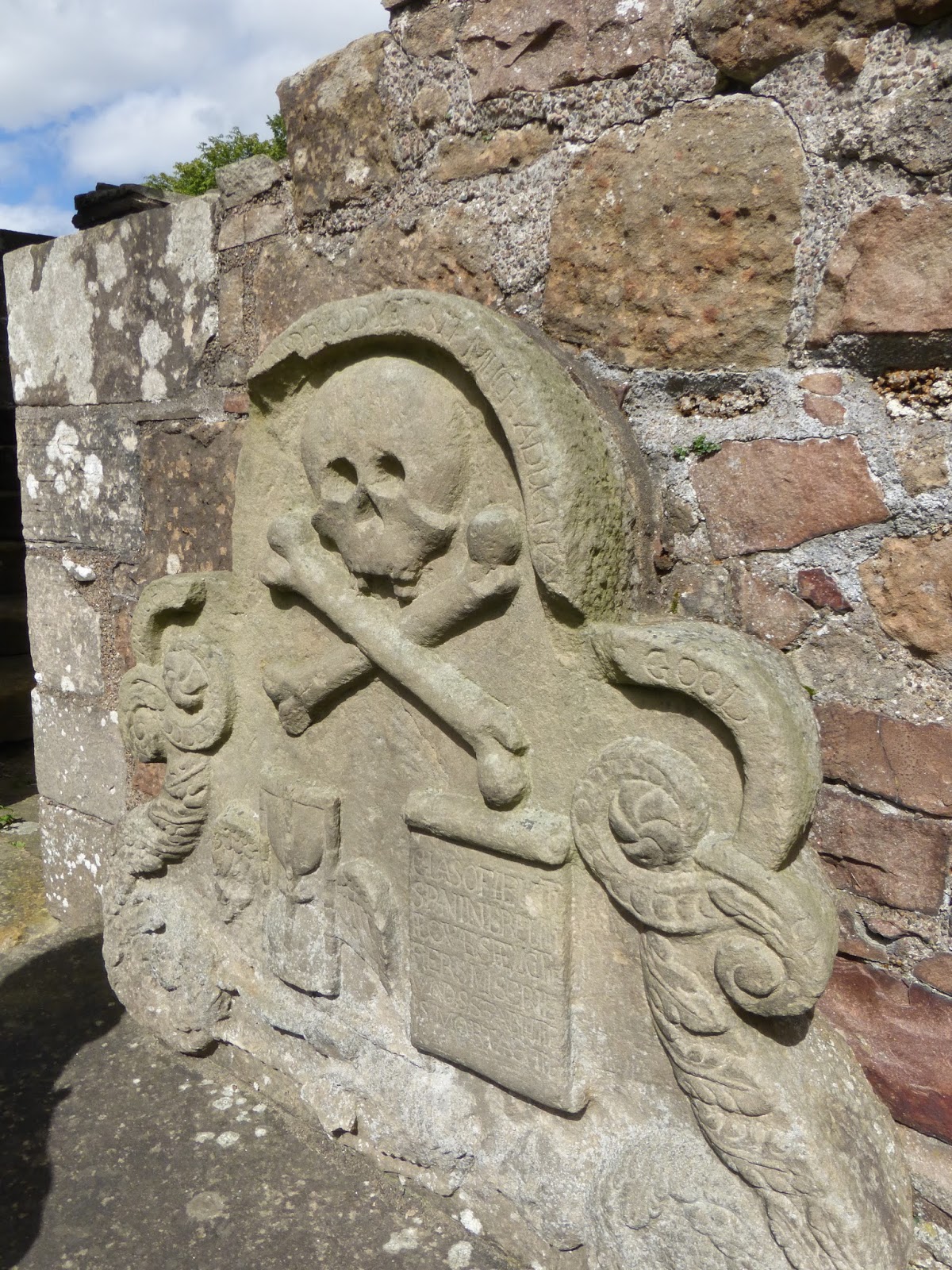
Elgin Cathedral Churchyard

Elgin Cathedral Churchyard, Moray, Scotland
Visited August 2015

Surrounding the ruined Medieval cathedral in Elgin, north-east Scotland, is a churchyard dating mostly from the 17th to 19th century. There are a few early 20th century burials, but the cemetery is now closed to burials. There are also some very worn pre-16th century gravestones, most of which would have been within the cathedral itself, which dates from the 13th century. If you're into social history, then the Victorian area with extensive inscriptions is fascinating - here are the sailors, fishermen, butchers, postmen and provosts of the town, and the many, many children who died in infancy.

The site is run by Historic Scotland, so you have to pay to get in if you're not a member of Historic Scotland, English Heritage or similar.


Friday, 31 July 2015

Greek Orthodox Cemetery, West Norwood


Greek Orthodox Cemetery, West Norwood Cemetery, London

Within the large Victorian cemetery at West Norwood, itself one of the ‘Magnificent Seven’, is an unique enclosed cemetery for the Greek Orthodox community which reflects two centuries of Anglo-Hellenic connections. The ground was acquired in 1842 by London's Greek community for a Greek Orthodox cemetery. Many monuments in the Necropolis feature neoclassical Greek designs, including columns, portico roofs, stepped bases and statues in togas. Today it is overseen by the trustees of the Cathedral of Saint Sophia, a Greek Orthodox church in Bayswater, West London.

The chapel of St Stephen and 18 monuments are listed by Historic England. The mortuary chapel of St Stephen was built in neo-classical style, and was built for merchant Stephen Ralli to bury his son, who had died in 1872 of rheumatic fever while at Eton.


Image
Plan of West Norwood Cemetery, c.1880 © London Borough of Lambeth. The Greek Cemetery, and chapel of St Stephen in particular, can be seen in the top left corner.

Saadian Tombs, Marrakesh

Saadian Tombs, Marrakesh, Morocco
Visited February 2011


The Saadian tombs in Marrakesh date back to the 16th and 17th centuries, and comprise the burials of over 50 members of the Saadian Dynasty. When the dynasty fell in 1696 the tombs fell into disuse and were forgotten about. They were rediscovered in 1917 and were restored by the Beaux-arts service. 

The mausoleums which house the tombs are wonderfully decorated with Islamic tiles, wood carvings, columns and pillars, and have a feel similar to the Moorish architecture of Southern Spain. As well as the monumental architecture, there’s also a quiet garden with smaller tombs for soldiers and servants.


To find the tombs, go to the ancient Kasbah and look for the Almohad Mosque, and follow the signs from there down a path. The site isn’t very big, and there isn’t any interpretation (so take a guidebook!), but it’s worth a visit. It doesn’t seem to be too busy (being just far enough away from the centre of town to discourage visitors who’d rather be in the suq!), so is a quiet, shady place to while away 30 min to an hour. 


Monday, 27 July 2015

Medieval Cadaver Tombs

Although I tend to only add short articles to this blog, and base it on sites I’ve visited, I’ve recently noticed a type of tomb in old churches and cathedrals which I’ve never spotted before and wanted to write about in a bit more detail.
I can’t believe I’ve walked past them and not noticed them (I’m drawn to depictions and symbols of death!), but since spotting one in Arundel earlier this year, I’ve been doing a bit of research into these ‘Cadaver Tombs’.

A cadaver tomb is a type of recumbent tomb featuing an effigy of the dead in the fom of a decomposing corpse, not quite a skeleton. They're known as 'transi', emphasising the transition they show between life and death. They were particularly characteristic of the later Middle Ages, appearing mainly from the mid-15th Century. 

In the versions which I've spotted so far, both of the 'double decker' type, a carved stone bier displays, on the top level, the recumbent effigy of the person as they were in life, and on the bottom level the person as a rotting cadaver, often shrouded (and apparently sometimes complete with worms and other flesh-eating creatures, although I haven't seen those so far). 

These tombs were made only for high-ranking nobles, bishops and the like, because they had to be rich to afford to have one made, and powerful enough to be allocated space for one in a church.  They are found in cathedrals and parish churches in England, although they are most common in continental Europe.

The earliest surviving one, in Lincoln Cathedral, is to Bishop Richard Fleming (also the founder of Lincoln College, Oxford), who died in 1431. It's built into a wall in the cathedral, and I managed to spot it just the other day.

Another I've seen recently, which was in wonderful condition, is the free-standing tomb of John FitzAlan, the 14th Earl of Arundel, who died in 1435. His tomb is in the Fitzalan Chapel in the grounds of Arundel Castle.


I'm not an expert in medieval burial practices or art, but I'm going to be looking out for these tomb types wherever I go now! Maybe I should take a look at photographs I've already taken in cathedrals across England - I bet there are one or two of these tombs lurking in the background!


Thursday, 4 June 2015

Lycian tombs, Turkey

Lycian Tombs, Turkey
visited September 2009


Ancient Lycia was a region in ancient Anatolia which is now in Southern Turkey. It became part of the Achaemenid Empire in the 6th century BCE, and was later part of the Macedonian Empire of Alexander the Great. 

The tombs left behind are quite spendid. The earliest are the tower tombs, with sarcophagi on top of a rock tower. The one below was in the middle of a town (Kas, ancient Antiphellos), and remarkably well preserved - no grafitti at all!

There are also rock cut Lycian tombs, which are a little later in date, and bring to mind the Nabatean rock cut tombs of Jordan - they really are like a mini Petra. The ones I saw, at Dalyan, were only seen from a boat due to time restraints, and a lot are hard to access. But if you have time, then I'm told there are some splendid rock cut tombs to be explored throughout the area.

An early pillar tomb, Kas

Back of the same pillar tomb

A rock cut tomb

Lycian tombs cut into the rock at Dalyan

Lycian tombs cut into the rock at Dalyan


Friday, 8 May 2015

St Machar's Cathedral, Old Aberdeen

St Machar's Cathedral, Old Aberdeen
Visited December 2014

St Machar's Cathedral in the Old Town part of Aberdeen, named after a disciple of St Columba who was instructed to build his church near where the River Don curves like the crook of a Bishop's staff. The current building dates from the 14th century onwards.

On a damp and cold December day it wasn't the most atmospheric of churchyards - it's very packed with gravestones, there are no spectacular monuments (it is Church of Scotland after all!), and no landscaping to speak of. But it was quiet, and the Cathdral is well worth a visit - the painted wooden ceiling is worth a visit alone.


Not St Machars... this is on the gate of St Peter's Cemetery near the Cathedral


Not a cemetery, but the wooden ceiling of St Machar's is worth a look

Sunday, 3 May 2015

1st Intermediate Period tombs, el-Mo'alla, Egypt

Tomb of Ankhtifi, a 9th Dynasty Egyptian governer, el-Mo'alla, Egypt
Visited February 2013

This is a very little-visited Egyptian tomb of the 9th Dynasty (1st Intermediate Period, c.2181–2055 BCE) which lies about half way between Esna and Luxor. The tomb is quite poorly preserved, although a roof has been put on it. What remains is a rock-cut funerary chapel with painted and carved decoration on the walls and columns, including scenes of farming, fishing etc. The most important thing, for Egyptologists (and the reason I visited), is an autobiographical text in hieroglyphs which describes a famine. Nearby is the smaller, even less well preserved tomb of Sobekhotep.