Pages

Thursday, 28 April 2016

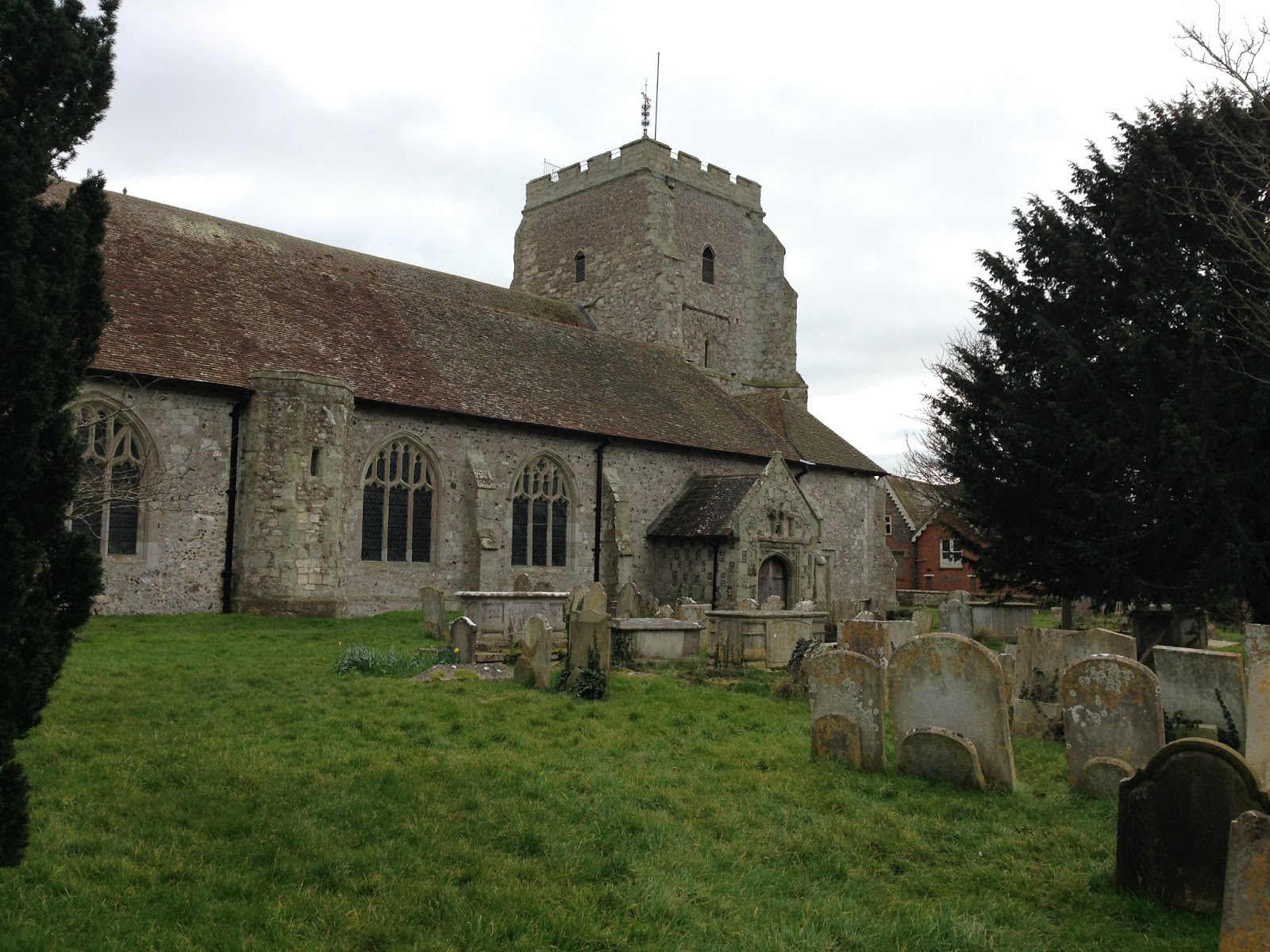
Churchyard of St Mary, Westham

Parish Church of St Mary, Westham, East Sussex
Visited March 2016

This church is believed to be the first built by the Normans after the conquest of 1066 (the site of the infamous battle of Hastings is nearby in the town of Battle). It stands close to the site of Pevensey Castle, and the two were probably connected. The church itself has original features dating back to the late 11th century, with renovations and restorations going up to the 20th century.

The churchyard is still in use, and most of the simple gravestones date from the 19th century onwards; I only managed to find one earlier stone with memento mori features on it. But, it's in a lovely country setting, so could easily be fitted in with a visit to the Castle. Look out, in one of the modern parts, for the graves from the 1930s most of which appear to have a coppiced tree growing out of them (no bones coming up with the roots, I checked!).


memento mori skull,St Mary's, Westham
 

Saturday, 16 April 2016

Forbes Mausoleum, Falkirk, Scotland

Forbes Mausoleum, Falkirk
Visited September 2015

The Forbes Mausoleum sits in the grounds of Callendar Park in Falkirk, and is located to the south east of Callendar House. It's about a 15 minute walk through the woods to the mausoleum, but you really don't want to walk there alone. 

It was designed in 1816 by Archibald Elliott in the Greek Doric style to house the remains of the Forbes family, who owned Callendar House from 1783 until the mid-20th century. It must have been impressive when build. Nowadays however, it's covered in graffiti as is the circular enclosure wall. The ground around it is covered in litter, empty bottles and traces of bonfires, and it just feels sad and neglected.
 
Forbes Mausoleum, Falkirk


Sunday, 10 April 2016

St Mary's Churchyard, Eastbourne

St Mary's Church, Old Town, Eastbourne, East Sussex
Visited March 2016

Although parts of this church date from the 12th century (more building went on in the 14th century, and there was a huge refurbishment in the Victorian period), most of the memorials in the churchyard are Victorian onwards. Apart from a small area to the east side, most of the gravestones have been cleared and lie against the walls. Part of the churchyard is still in use, as a garden of rest for cremations of parishioners. 

There are a few older monuments around, and (perhaps rather randomly) a Celtic cross brought from Cornwall to Eastbourne in 1817, which probably dates to the 12th century. It's not worth making the journey to visit the churchyard alone, but the church itself is lovely. No pictures, as there was a service when I was there, but it retains some splendid original features including stone carvings.


Tuesday, 29 March 2016

Churchyard of St George the Martyr, Ramsgate

Churchyard of St George the Martyr, Ramsgate, Kent
Visited March 2016

The rather magnificent Gothic church of St George the Martyr in the centre of Ramsgate dates from the 1820s, so there aren't any gravestones older than this in the churchyard. Most of the Victorian and Edwardian gravestones have been cleared, and are propped around the walls. A few table tombs and other large monuments have been left in situ, although none are really of great interest, either in their decoration or inscriptions. 

There is a small garden of remembrance in one corner, and it's worth noting that among those whose ashes have been buried here is John Le Mesurier, of Dad's Army fame. 
Photo taken from Pinterest (as light wasn't good enough on my visit)
The churchyard is treated as a park by dog walkers, and it's worth passing through but don't make a special trip into town to see it - much better to go to St Lawrence.


Wednesday, 23 March 2016

Falkirk Old Parish Church, Scotland

Churchyard of Falkirk Old Church, Stirlingshire, Scotland
Visited September 2015

Falkirk Old Parish Church is a medieval building dating back to around the mid 15th century, although there have been churches on the side since about the 6th century (the Faw Kirk, or 'speckled church' was the first, and gave the town its name). As with many churches of this period, a lot of renovation, rebuilding and restoration was done in the 19th century.

The churchyard was pretty much cleared in the 1960s, although what remains contains some notable burials. In most cases their markers are replacements for the originals. They include the tomb of Sir John de Graeme, and that of Sir John Stewart of Bonkyll. Both died while fighting for William Wallace at the Battle of Falkirk in 1298. Other tombs commemorate men who died in the Battle of Falkirk Muir, part of the Jacobite uprisings of 1746. At the East end of the church is the Zetland mausoleum, where the Dundas family (Earls of Zetland) were buried.

Some of the old gravestones which were cleared can still be seen, reused as paving slabs in the pathways of the churchyard. If you're in town (going to see the Kelpies or the Falkirk Wheel, for example) do stop off here - the interior of the church is also worth visiting, if it's open.


Sunday, 20 March 2016

Turriff Cemetery, Aberdeenshire

Turriff Cemetery, Aberdeenshire, Scotland
Visited August 2014

Turriff is a reasonably small town in North East Scotland, best known (at least in the area) for the Turriff Show, which is why I was in town.

I didn't actually go into this cemetery, but as it was adjacent to the area where the Turriff Show was taking place (think proper agricultural show, with horses, sheep, cows, fancy pigeons, the works!) it seemed a shame not to take some pictures. And it gave me a good reason to link to info about the Turra Coo, which became famous due to a tax protest https://en.wikipedia.org/wiki/Turra_Coo!

The cemetery is on Balmenie Road in Turriff, and dates from 1878 - before that burials took place in Turriff Kirkyard. It's still in use today. Not much else I can say due to viewing it at a distance, but google images suggests a rather nondescript, landscaped area, although it does seem to have some mature trees, and some wildflowers, so all is not lost!


Thursday, 3 March 2016

Highgate Cemetery (East Side), London

 Highgate East Cemetery, London
Visited May 2013

The east side of Highgate Cemetery is separated from its older sibling, the west cemetery, by a road. The eastern half was opened in 1860 due to the popularity of the west side, and is now open to the public. Like the west side, there's an admission charge although you don't have to go on a guided tour of this side, instead you can wander freely around it.

The graves in this side date from the Victorian period to the modern day - the most famous resident is of course Karl Marx, but others buried here include Patrick Caulfield, George Eliot, Jeremy Beadle and Douglas Adams. A most eclectic mix!

As with the west side, there's a lot of trees and overgrown areas here, although other parts, with the more modern burials, are better tended in terms of mown lawns etc. As you'd expect from somewhere so famous, and with an entrance charge, there are leaflets and maps available and the paths are in good condition. It may seem busy when you go in, but get away from the main path and Marx and there's still solitude to be found here. Beautiful in springtime with the flowers growing among the gravestones.

Douglas Adams, author of the Hitchhiker's Guide to the Galaxy

Karl Marx


This chap invented Hovis bread!